“Our dynamic interaction with our different environments is what remains constant”
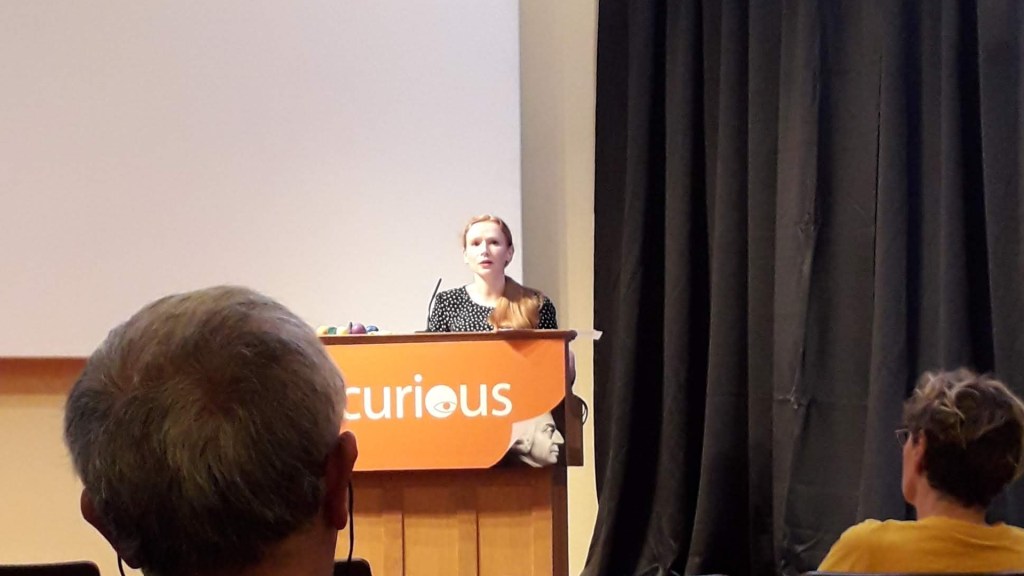
What do cognitive science, smartphones, clay, and literature have to do with each other? In Dr Miranda Anderson’s excellent talk, “Where is your mind?”, these elements came together in what was closer to a thought or social experiment than an academic lecture. Dr Anderson took her audience on an engaging journey through the history of human culture in order to show the human mind’s tendency to spill out of its physical confines.
Dr Anderson started us off with some important conceptions of mind in recent history: 1) Descartes and his mind-body dualism; 2) the mind-equals-brain idea; and, finally, 3) the extended mind hypothesis, first advanced by Andy Clark and David Chalmers in the late 90s. In a nutshell, after philosophy of mind broke away from Cartesian dualism, which posited an essential division between body and mind, it turned more specifically to the problem of where the mind is. Clark and Chalmers revolutionised the issue by proposing that the mind extends across brain, body, and world. In their famous 1998 article, “The Extended Mind”, they gave us one of the paradigmatic examples of extended cognition: Inga and Otto’s visit to the Museum of Modern Art. Both Inga and Otto want to go to the museum. While Inga has stored in her memory the address of the museum, Otto, who suffers from Alzheimer’s disease, has written down the same information on a piece of paper. Inga and Otto’s brains are part of the cognitive process of remembering the address of the museum: that much is uncontroversial. But isn’t the piece of paper part of Otto’s cognitive process as well?
In order to exemplify this counter-intuitive idea, Dr Anderson made use of the quintessential modern paradigm of extended cognition: the smartphone. She asked us to think of some functions performed by smartphones. Navigation, lists of favourite stuff, and reviews of shows in the Fringe festival were some of the suggestions. We offload a variety of processes to external resources (including other people – something which Stephen Kosslyn has called social prosthetics systems). When Dr Anderson asked us if we knew what time it was, we checked our phones: we know what time it is because our phones store that information. This knowledge is not in the brain, but in the world, and we have it because we have access to it. Knowledge is standardly conceptualised as an internal resource, but it can be stored “externally”, and it has been so throughout history.
More than five millennia ago, the Sumerians used a token-based recordkeeping strategy in which different clay shapes represented different commodities (oil, grain, etc.). At the beginning of the talk, Dr Anderson gave some of us a piece of modelling clay and asked us to mould it into different shapes, with which she exemplified the Sumerian recordkeeping system. The original clay tokens were stored inside “pita bread” style clay envelopes. The shapes of the tokens were then inscribed on the outside of these envelopes so that one could know what was inside without cracking them open. With time, tokens became disposable, while the corresponding signs developed into one of the first known writing systems. This is a clear case of abstract thought evolving from material engagement with the world. And by involving the audience with an arts and crafts task, Dr Anderson made this even more evident. Both tokens and linguistic signs store knowledge outside the brain. Of course, “external” resources are different from “internal” cognitive capacities, but these differences are also integral to the human cognitive processing of the world: we can use them to our advantage. So, for instance, when we write something on a piece of paper, that information is more stable than the one in our memory.
Dr Anderson pointed out that the common concern about “smartphones making us stupider” is a modern formulation of an old anxiety. When writing started gaining traction, people were concerned that it would discourage use of memory: relying on an external resource would cause our internal resources to wither. For instance, in Plato’s Phaedrus (274C-275d), Socrates worries about writing and its impact on memory. Ironically, we only know this because Plato wrote it down. Similar fears surfaced again with the advent of printing, which, according to 15th-16th century abbot Johannes Trithemius, was a threat to the art of manually copying manuscripts (De laude scriptorum manualium, “In praise of scribes”, 1492). But, as Montaigne put it, the relation between human and resource is a feedback loop: “I have no more made my book than my book has made me” (“Je n’ai pas plus fait mon livre que mon livre m’a fait”, in “Du Démentir”, Book 2, chapter 18). Different resources give us different avenues to explore our cognitive capacities. New technologies are not a matter of catering to our laziness and deadening our abilities, but a matter of using these abilities them in new ways. Indeed, as Dr Anderson pointed out, “our dynamic interaction with our different environments is what remains constant.”
Finally, when Dr Anderson opened the floor for questions, an inevitable sceptic hand went up immediately. Discussions on extended and distributed cognition invariably bring up the following objection: why should we consider “external” things as part of the cognitive process, and not as aids to it? To paraphrase the audience member who asked the question, if we have a glass of wine, we do not say that the glass is wine. But, as I see it, this is not equivalent to the premise of extended cognition: wine and glass are different substances (i.e. in terms of chemical composition and corresponding physical properties), while the world and cognition can never be differentiated in these terms. If we get rid of the glass, we still have wine, and vice-versa. Their relationship is not mutually constitutive. If we get rid of the world, however, we do not have cognition. Going back to Clark and Chalmers, we can reformulate the core objection as follows: is the piece of paper with the museum address part of Otto’s cognitive process of knowing the address, or just an aid to it? Without the piece of paper, Otto would not know the address; with it, he does.
For me, Dr Anderson’s talk was an enlightening and persuasive substantiation of the extended cognition premise through different historical examples. The question at the end shows that this approach needs all the promotion it can get, as it is, indeed, counter-intuitive. We tend to conceptualise cognitive faculties (e.g. intention, emotion, decision-making, etc.) as things that exist inside our body. But anxiety about extended cognition has to do also with the utility of the concept: if cognition spills out of its traditional confines, then what isn’t cognition? First, not all the world is part of cognition all the time. The piece of paper with the address to the Museum of Modern Art is not always a part of a cognitive process just because it can be. Our biological structures are always cognizing, and they do so with/through/because of the world around them, but the world itself comes in and out of the cognitive process. At the same time – and this is the point – cognition is not something that exists without the world. We can drink wine from many different containers, but we cannot cognize without an environment. Human cognition is precisely the processing of the world by a human body, and not a brain in a vacuum. Cognition is in no way abstract, but a situated, contextual, unique process that emerges whenever a body is in an environment. If the proverbial tree falls in a forest and no one is around to hear it, then there is no cognitive event.
by Inês Silva
*This is not an exhaustive description of Dr Anderson’s talk. I picked some topics of interest on which to focus more specifically.
See Dr Anderson’s staff page at the University of Edinburgh for more details on her career, research interests, and publications.
 Ideas Are Food